Light vs Dark Brown Sugar
Light and dark brown sugar are both granulated sugar with molasses added back in. Dark brown sugar has more molasses, about 6.5 percent against about 3.5 percent in light, according to King Arthur Baking. That makes dark brown sugar darker and stronger in flavor, and light brown sugar milder. In most recipes you can use either. They weigh the same, so a swap does not change the amounts: 1 cup of packed brown sugar is 213 grams.
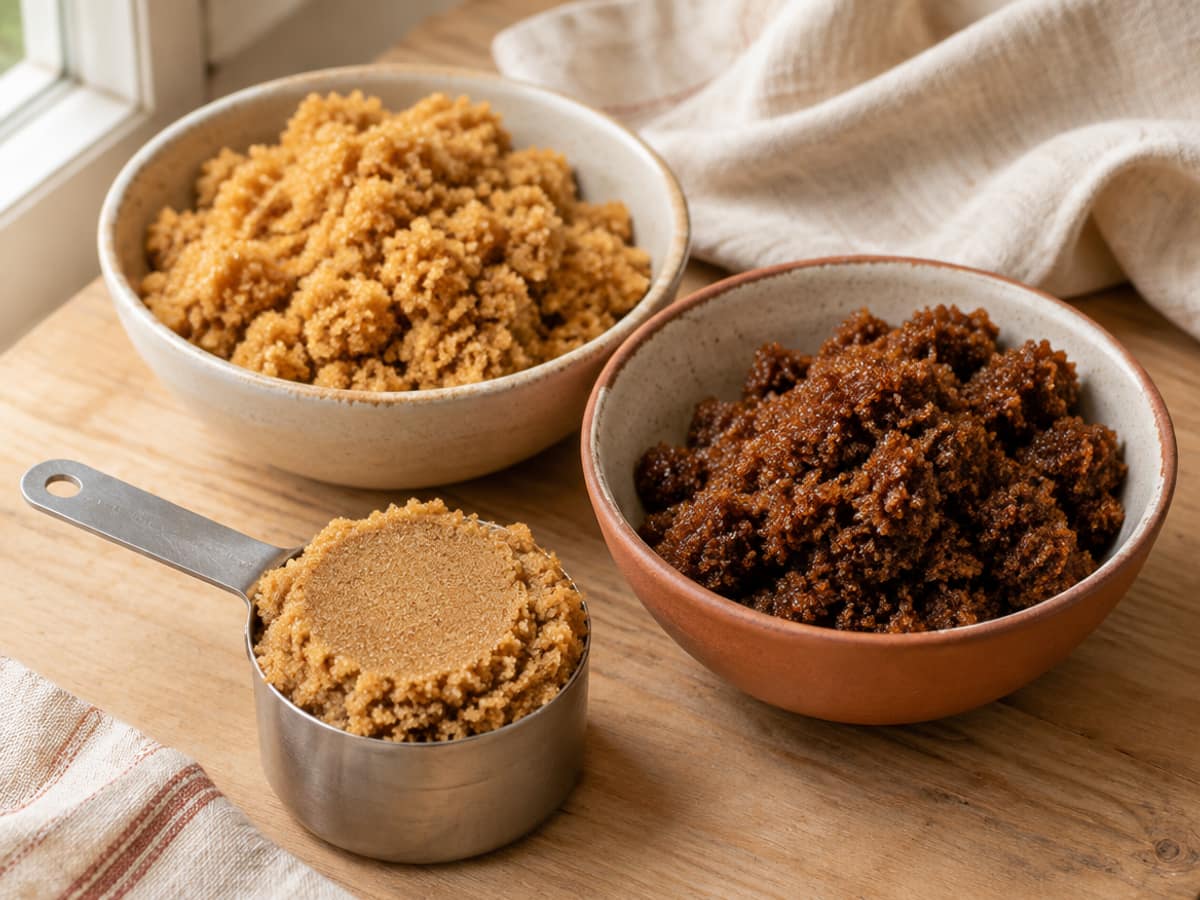
Side by side
| Light brown sugar | Dark brown sugar | |
|---|---|---|
| Molasses | About 3.5 percent | About 6.5 percent |
| Color | Golden to light tan | Deeper brown |
| Flavor | Mild caramel | Stronger, more molasses |
| Moisture and chew | Moist | Moist, with a little more molasses |
| Weight per packed cup | 213 g | 213 g |
| Swap for the other? | Yes, 1 to 1 | Yes, 1 to 1 |
| Best for | Cookies where you want a gentle caramel note; sauces and glazes that should not darken | Gingerbread, baked beans, barbecue sauce, cookies with a bold flavor |
The molasses percentages and the statement that the two weigh the same come from King Arthur Baking. The flavor and use notes are general guidance, not test results.
What brown sugar is
Brown sugar used to be sugar that kept some of its natural molasses through processing. Today most of what you buy is white granulated sugar with molasses added back in, up to 10 percent molasses by weight, King Arthur says. That is why you can make a stand-in from white sugar and a small amount of molasses. Recipes for homemade brown sugar vary, so follow the one you trust and taste the result.
Can you swap them?
Yes. King Arthur says the difference in color and flavor will not be obvious in baked goods, and the small difference in acidity, since molasses is acidic, will not change how leaveners perform in a noticeable way. If a recipe names light or dark, use that when you can. If it says only “brown sugar,” use either.
A few cases where the choice shows:
- Pale batters and glazes. Light sugar keeps a vanilla cake or a clear glaze from turning muddy.
- Strong flavors. Dark sugar stands up to ginger, coffee and chocolate.
- Chewy cookies. Both keep cookies soft. See chewy chocolate chip cookies and crispy chocolate chip cookies for how the brown-to-white sugar ratio changes texture.
For more on how brown sugar behaves in cookie dough, see chocolate chip cookie ingredients.
Why brown sugar matters for rising
Molasses is acidic, so brown sugar adds a little acid to a dough. That is part of why the classic chocolate chip cookie leans on baking soda: the soda reacts with the acid in the brown sugar. King Arthur says the difference between light and dark is too small to change how a recipe’s leaveners perform in a noticeable way, so swapping one for the other does not call for any change to the baking soda. If you are curious how soda and acid work together, see baking soda vs baking powder.
Choosing for the dish
If you bake mostly cookies and cakes, one bag of light brown sugar covers nearly everything. Keep a bag of dark brown sugar as well if you cook gingerbread, baked beans or barbecue sauce, where the stronger molasses flavor is the point. If you only want one bag, either works; you will just notice the difference in the flavor of the finished dish, and the color of a pale batter, more than in how it bakes.
How to measure it
Brown sugar is measured packed. Press it firmly into the cup until it holds the shape of the cup when you turn it out. A packed cup is 213 grams in this site’s recipes (the full chart lists the other amounts), and King Arthur’s weight chart gives the same number for light or dark brown sugar. If you have a scale, weigh it and skip the packing.
How to keep it soft
Brown sugar hardens when it loses moisture. King Arthur explains that if it sits out too long, the moisture evaporates and the sugar crystals stick together into a solid, dry mass. The best fix is prevention: keep it in an airtight container or a tightly closed bag.
If it has already turned hard:
- Put the sugar in an airtight container or resealable bag.
- Lay a slice of soft sandwich bread on top and seal it.
- Leave it for about 24 hours, or at least overnight. The sugar absorbs moisture from the bread and softens.
- Remove the bread. Replace it if you plan to leave the sugar for weeks.
King Arthur describes other methods too, such as a terracotta disk or working water into the sugar. The bread method needs nothing special.
Quick answers
- No dark brown sugar? Use light, 1 to 1.
- No brown sugar at all? Mix white sugar with a small amount of molasses, per King Arthur, or use white sugar, which gives a paler cookie with less caramel flavor. Chocolate chip cookies without brown sugar is a full recipe built that way.
- Does it matter for the recipes on this site? Not for the amounts. The cookies in this section use light brown sugar unless a recipe says otherwise, and dark works the same way with a stronger flavor.
For other baking staples, see baking basics, and for the cookie that uses it most, the classic chocolate chip cookie recipe.
Questions and answers
Can I use light and dark brown sugar interchangeably?
Yes. King Arthur Baking says the difference in flavor and color is not obvious in most baked goods, and the two weigh the same, so you can swap them by weight or volume. Use the type the recipe names if you have it.
What is the difference between light and dark brown sugar?
Molasses. King Arthur says dark brown sugar has about 6.5 percent and light has about 3.5 percent, so dark is darker with a stronger flavor.
How much does a cup of brown sugar weigh?
On this site, 1 cup of packed brown sugar is 213 grams, whether it is light or dark.
How do I soften hard brown sugar?
King Arthur suggests sealing the sugar in an airtight container or bag with a slice of soft sandwich bread for about 24 hours, so the sugar absorbs moisture from the bread.
Sources
- Light vs. dark brown sugar: What's the difference? And can I substitute one brown sugar for another? — King Arthur Baking
- How to soften brown sugar — King Arthur Baking
- Ingredient weight chart — King Arthur Baking