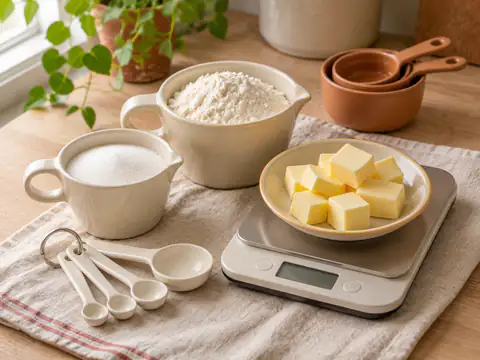
Cake Flour Substitute
To replace 1 cup (120 g) of cake flour, whisk 105 g of all-purpose flour with 14 g of cornstarch, then sift it. By volume, that is 1 cup of all-purpose flour with 2 tablespoons taken out and 2 tablespoons of cornstarch added. The cornstarch dilutes the gluten-forming protein so the cake bakes up tender.
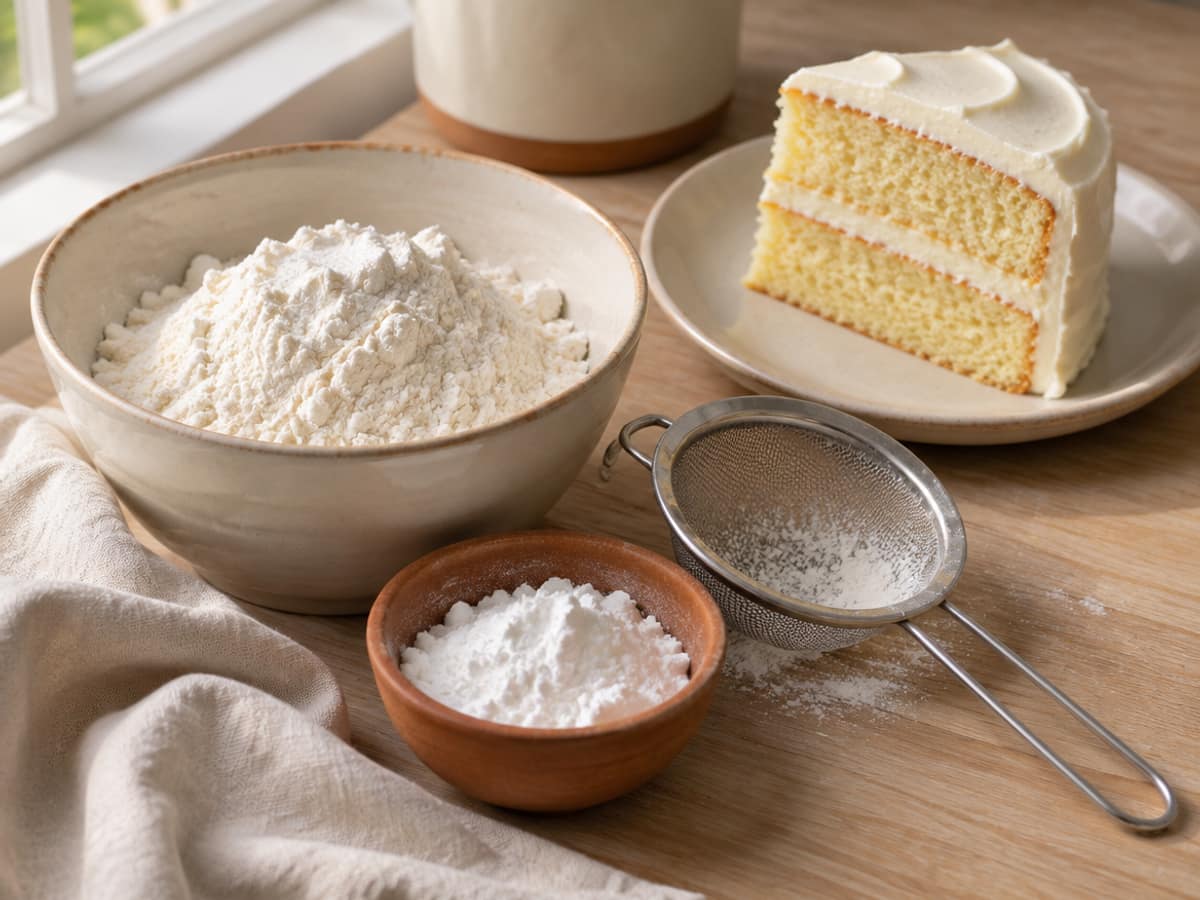
Use the mix in place of cake flour at equal weight. The table gives amounts from 1/4 cup to 2 cups. Cake flour is one of the weights in the baking conversion chart, and more basics are in baking basics.
Amounts by weight
Weigh the flour and the cornstarch together into one bowl. Cake flour is 120 g per cup on this site (King Arthur’s figure), and the mix is built to match it.
| Cake flour called for | In grams | All-purpose flour | Cornstarch |
|---|---|---|---|
| 1/4 cup | 30 g | 26 g | 4 g |
| 1/3 cup | 40 g | 35 g | 5 g |
| 1/2 cup | 60 g | 53 g | 7 g |
| 2/3 cup | 80 g | 70 g | 9 g |
| 3/4 cup | 90 g | 79 g | 11 g |
| 1 cup | 120 g | 105 g | 14 g |
| 1 1/2 cups | 180 g | 158 g | 21 g |
| 2 cups | 240 g | 210 g | 28 g |
The 1-cup row is King Arthur’s: 105 g of all-purpose flour and 14 g of cornstarch. The other rows scale it, rounded to whole grams, so a row can be 1 g off the total.
Amounts by cups and spoons
| Cake flour called for | All-purpose flour | Cornstarch |
|---|---|---|
| 1/2 cup | 7 tablespoons | 1 tablespoon |
| 1 cup | 7/8 cup (14 tablespoons) | 2 tablespoons |
| 2 cups | 1 3/4 cups | 1/4 cup |
The spoon version runs a little heavier than the gram version. On this site 7/8 cup of all-purpose flour is about 109 g and 2 tablespoons of cornstarch is about 14 g (King Arthur lists 28 g for 1/4 cup), which makes 123 g against 120 g of cake flour, about 2 or 3 percent more. A scale removes that gap. If you only have cups, the volume version still works, since the University of Arkansas Cooperative Extension Service gives the same method: measure 1 cup of all-purpose flour, remove 2 tablespoons, add 2 tablespoons of cornstarch.
How to make it
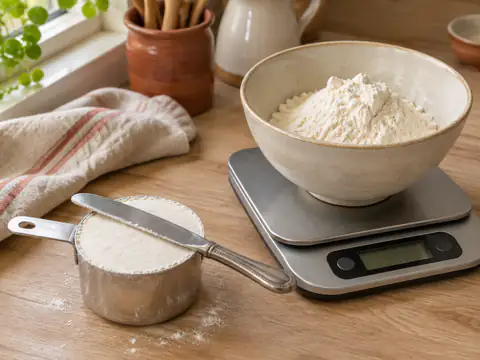
- Weigh or measure the all-purpose flour into a bowl. Use the spooned and leveled method from how to measure flour.
- Add the cornstarch.
- Whisk well, then sift the mix through a fine sieve into a second bowl.
- Sift it a second time. Arkansas Extension says to sift twice, which mixes the two and adds air, so the result feels like real cake flour.
- Use it right away, in place of the cake flour in the recipe, at equal weight.
If the recipe tells you to sift the flour with baking powder or cocoa, do that step after this one.
Why it works
Cake flour is lower in protein than all-purpose flour. Protein forms gluten, which gives structure. A cake wants a soft, fine crumb, so less gluten helps. Cornstarch has no gluten-forming protein, so replacing a little of the flour with it lowers the protein of the whole mix. Arkansas Extension puts it simply: cornstarch contains less gluten than flour.
The same idea is why a spoonful of cornstarch softens some cookies. The cookie version is in what does cornstarch do in cookies.
When it matters and when it does not
- Light, tender cakes: This is where the substitute helps most. King Arthur’s cake flour recipes include white cake, vanilla cupcakes and angel food cake.
- All-purpose flour alone: It is usually fine in a pinch. King Arthur says you will get a similar cake with a slightly coarser crumb.
- Cake flour in an all-purpose recipe: Do not swap it 1 for 1. King Arthur’s Senior Recipe Developer says it can give a sunken cake or bars, or cookies that fall apart, because the lower protein may not build enough structure.
- Cookies, bread and biscuits: These are built on all-purpose or bread flour. Leave the recipe as written.
None of the cakes on this site needs the substitute, because they were written with all-purpose flour. That covers chocolate cake with cocoa powder, one-bowl chocolate cake, chocolate sheet cake and the cakes in 15 easy chocolate cake ideas. Use this page when you meet a recipe from another source that asks for cake flour.
A worked example
A recipe from another source asks for 1 1/2 cups (180 g) of cake flour.
- Weigh 158 g of all-purpose flour into a bowl.
- Add 21 g of cornstarch.
- Whisk, sift twice and use all of it, about 179 g, in place of the cake flour.
With cups instead of a scale, measure 1 1/2 cups of all-purpose flour, take out 3 tablespoons, and add 3 tablespoons of cornstarch. That is the same method as the 1-cup version, with every amount multiplied by 1 1/2.
What can go wrong
- Packed cornstarch: Spoon the cornstarch into the measure and level it, or weigh it.
- Skipping the sifting: The cornstarch may stay in streaks. Sift twice.
- Using cornstarch for a larger share of the flour: King Arthur’s ratio is about 12 percent of the weight. More than that is not covered by these sources.
Questions and answers
How do you make cake flour from all-purpose flour?
For each 1 cup of cake flour, use 105 g of all-purpose flour and 14 g of cornstarch (King Arthur Baking's weights). By volume, measure 1 cup of all-purpose flour, take out 2 tablespoons, add 2 tablespoons of cornstarch and sift twice.
Can I use all-purpose flour instead of cake flour?
Yes, in a pinch. King Arthur Baking says the cake will be similar, with a slightly coarser crumb and a little less tenderness.
Can I use cake flour instead of all-purpose flour?
Not 1 for 1. King Arthur Baking says cake flour in a recipe made for all-purpose flour can give a sunken cake or bars, or cookies that fall apart.
How much does a cup of cake flour weigh?
On this site, 120 grams, spooned and leveled, from King Arthur Baking's weight chart. USDA FoodData Central lists 137 grams for a dipped, scooped cup.
Sources
- Cake flour vs. all-purpose flour: What's the difference, and how do I substitute? — King Arthur Baking
- What You Need to Know About Flour — University of Arkansas Cooperative Extension Service
- Ingredient Weight Chart — King Arthur Baking
- Wheat flour, white, cake, enriched — USDA FoodData Central