How to Soften Butter to Room Temperature
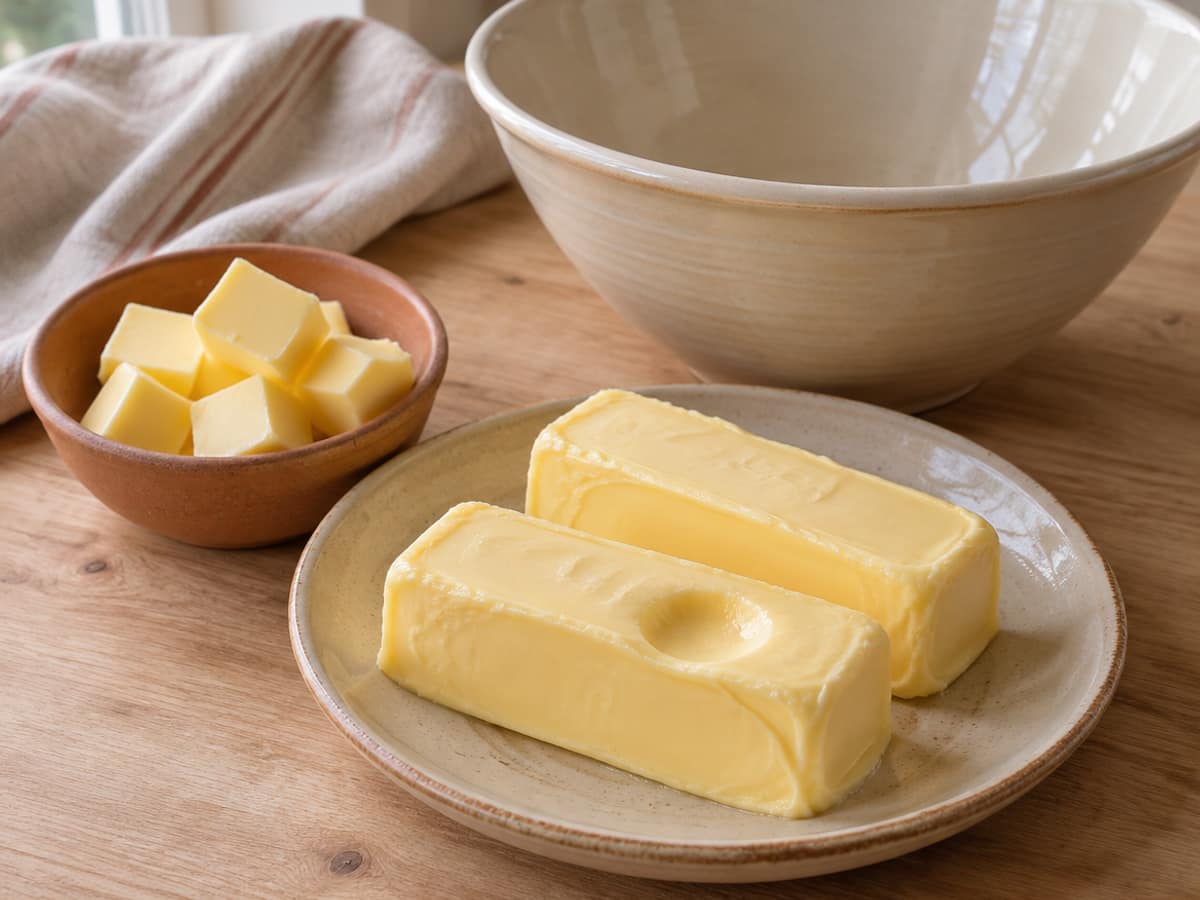
Butter is softened when a finger leaves a clean dent but cannot push through to the bottom. It should feel like cool clay, not greasy. The fastest method that King Arthur Baking tested was a stick standing on its end in a 1000-watt microwave for about 8 seconds per end. Without a microwave, slice the stick and leave it on a plate for about 30 minutes.
Most cookie, cake and frosting recipes start with softened butter, including the classic chocolate chip cookie recipe. This guide covers how to tell, how to speed it up and what to do when it goes too far. More basics are in baking basics.
How to tell when butter is ready
King Arthur’s bakers use the finger test: press the butter. It should give way and leave an indent, but with some resistance. If your finger goes all the way through, the butter is too warm. If you want a number, King Arthur gives 68°F to 72°F (20°C to 22°C) as the “plastic” range, where butter has softened but holds its shape. Every recipe on this site uses that range, so a dent that holds its shape is the cue to trust, and the thermometer is only a check.
| Butter is | What you see and feel | What to do |
|---|---|---|
| Too cold | Hard, the finger barely marks it, and it breaks into chunks in the bowl | Wait, or slice it and give it 10 more minutes |
| Ready | A finger makes a clean dent with some resistance; the surface is dull, not shiny | Use it now |
| Too soft | The finger sinks through; the surface looks shiny or greasy | Chill it for 10 to 15 minutes, stirring once |
| Melted | Liquid, or separated into fat and milky water | Use it in a recipe that calls for melted butter |
Why the temperature matters
When you cream butter and sugar, the sugar crystals cut tiny air pockets into the butter. King Arthur explains that if the butter is too cold, the sugar cannot make air pockets well and the baked goods turn out dense. If the butter is too soft, it cannot hold the air, and a greasy, wet mixture is the result. In cookies, butter that is too warm is one of the common reasons cookies spread flat. The causes and fixes are in why are my cookies flat, and the effect of chilling the dough is in chocolate chip cookie dough: make ahead, chill and freeze.
Ways to soften butter, with times
These times come from King Arthur’s tests in a 73°F (23°C) kitchen and with a 1000-watt microwave. Your kitchen, your butter and your microwave will change them, so treat them as planning ranges and check with the finger test.
| Method | How | Time | Notes |
|---|---|---|---|
| Whole stick on the counter | Leave it on a plate | 2 to 5 hours | Hard to overdo, but you must plan ahead |
| Sliced on a plate | Slice the stick into pieces and spread them out | About 30 minutes | Hard to overdo; works without a microwave |
| Microwave, stick on its end | Stand the stick on its end on a plate, microwave 8 seconds, flip and do 8 seconds on the other end | About 16 seconds | King Arthur’s favorite; evenly soft, though one test ran slightly too soft, so start with 7 seconds |
| Microwave, stick lying down | Lay the stick flat and microwave in 5-second bursts, turning a quarter turn | About 20 seconds | Uneven: some patches greasy, others still hard |
| Warm water bath | Wrapped stick in barely warm tap water | 10 to 15 minutes | Easy to overdo; soft outside and cold inside |
| Hot bowl over the butter | Warm a bowl with hot water, then place it upside down over the butter | About 12 minutes | The inside stayed cold in King Arthur’s test |
The easiest option from King Arthur’s results: slice the butter and use the time to measure the other ingredients. If you are in a hurry and have a microwave, use the stick-on-end method, and stop early. Microwaves differ, so start with a few seconds less than King Arthur’s times.
Step by step: the sliced-butter method
- Take the butter from the refrigerator and cut it into slices or tablespoon-size cubes.
- Spread the pieces on a plate so they do not touch.
- Leave them at room temperature for about 30 minutes.
- Press one piece. When it dents without feeling greasy, use it. If it is still hard in the middle, give it 5 to 10 more minutes.
Step by step: the microwave method
- Unwrap the stick and stand it on one end on a microwave-safe plate.
- Microwave for 8 seconds. Flip it onto the other end.
- Microwave for 8 more seconds, or for 7 if your microwave runs hot.
- Press with a finger. It should dent without squishing through. If it is still firm, add 3 seconds at a time.
If the butter gets too soft or melts
If it is only a little too soft, chill it for 10 to 15 minutes and check again. If it has started to melt, King Arthur’s bakers say it is better not to use it for creaming, because the structure of the butter has changed, and air bubbles will not hold. They say butter that melted and set again may be separated or grainy. It is fine for toast, pancakes or recipes that call for melted butter, such as chocolate chip cookie bars, which use melted butter on purpose.
When butter should stay cold
Soft butter is for tenderness and for creaming air in. For flakiness, butter should stay solid so it stays in pieces in the dough. King Arthur’s pastry guide says solid butter stays in layers for a flaky crust, and its biscuit recipe says cold butter gives higher-rising, layered biscuits. If a recipe says “cold butter,” do not soften it.
Keeping butter safe while it softens
University of Maine Cooperative Extension says unsalted butter should be stored in the refrigerator and removed only briefly to soften, and that extended counter storage is not recommended. Salted butter, in a covered dish and below 70°F (21°C), can stay out for up to one to two days. Warmer rooms make butter go rancid faster. So take unsalted butter out when you need it, not days ahead, and if butter smells rancid, throw it out.
King Arthur also says butter that only softened, and stayed below 70°F (21°C), can go back in the refrigerator, and it will still work later.
For the flour side of creaming, see how to measure flour.
Questions and answers
How long does it take to soften butter?
King Arthur Baking's tests took 2 to 5 hours for a whole stick on the counter in a 73°F (23°C) kitchen, about 30 minutes for a sliced stick on a plate, and about 16 seconds in a 1000-watt microwave with the stick standing on its end.
What temperature is softened butter?
King Arthur Baking gives 68°F to 72°F (20°C to 22°C) as the range where butter is soft but still holds its shape. Recipes on this site use the same range.
Can I put softened butter back in the fridge?
Yes, if it only softened. King Arthur Baking says butter that has only been soft and stayed below 70°F (21°C) can go back in the fridge. Butter that melted and set again may be grainy and is better for toast than for creaming.
Can I leave butter on the counter?
University of Maine Cooperative Extension says unsalted butter should be kept in the refrigerator and taken out only briefly to soften. Salted butter can sit covered below 70°F (21°C) for one to two days.
Sources
- Baking trials: How to soften butter quickly — King Arthur Baking
- Why does butter temperature matter in pastry? — King Arthur Baking
- Creaming butter and sugar: How to get it right — King Arthur Baking
- Buttermilk Biscuits — King Arthur Baking
- How long can butter sit out? — King Arthur Baking
- Is It Actually Safe to Leave Butter on the Counter? — University of Maine Cooperative Extension