Chocolate Mug Cake
A chocolate mug cake is a single-serving cake you mix and cook in the mug in the microwave. This one is eggless: flour, sugar, cocoa, baking powder, milk, oil and vanilla go into a 12-ounce mug, and it cooks in 70 to 90 seconds at 1000 watts. Every amount is in spoons and grams. It makes one cake for one person, and the whole job takes about 8 minutes. For bigger cakes, see the chocolate desserts hub and 15 easy chocolate cake ideas.
Recipe
Chocolate Mug Cake (eggless, one mug)
- YieldOne mug cake in a 12-ounce (350 ml) mug
- Prep5 min
- Cook2 min
- Chill / rest1 min
- Total8 min
Ingredients
In the mug
- 4 tbsp31 g all-purpose flour, spooned and leveled
- 3 tbsp38 g granulated sugar
- 2 tbsp11 g unsweetened cocoa powder
- 1/4 tsp1 g baking powder
- 1 pinchunder 1 g fine salt
- 4 tbsp60 ml milk
- 2 tbsp30 ml neutral oil or melted butter
- 1/4 tsp1 ml vanilla extract
- 1 tbsp11 g chocolate chips, optional
Method
- Add the flour, sugar, cocoa, baking powder and salt to the mug and stir with a fork until no streaks of cocoa remain. Press out any lumps against the side.
- Add the milk, oil and vanilla. Stir well, scraping the bottom and corners where dry flour hides, until the batter is smooth.
- Stir in the chocolate chips. The mug should be no more than half full.
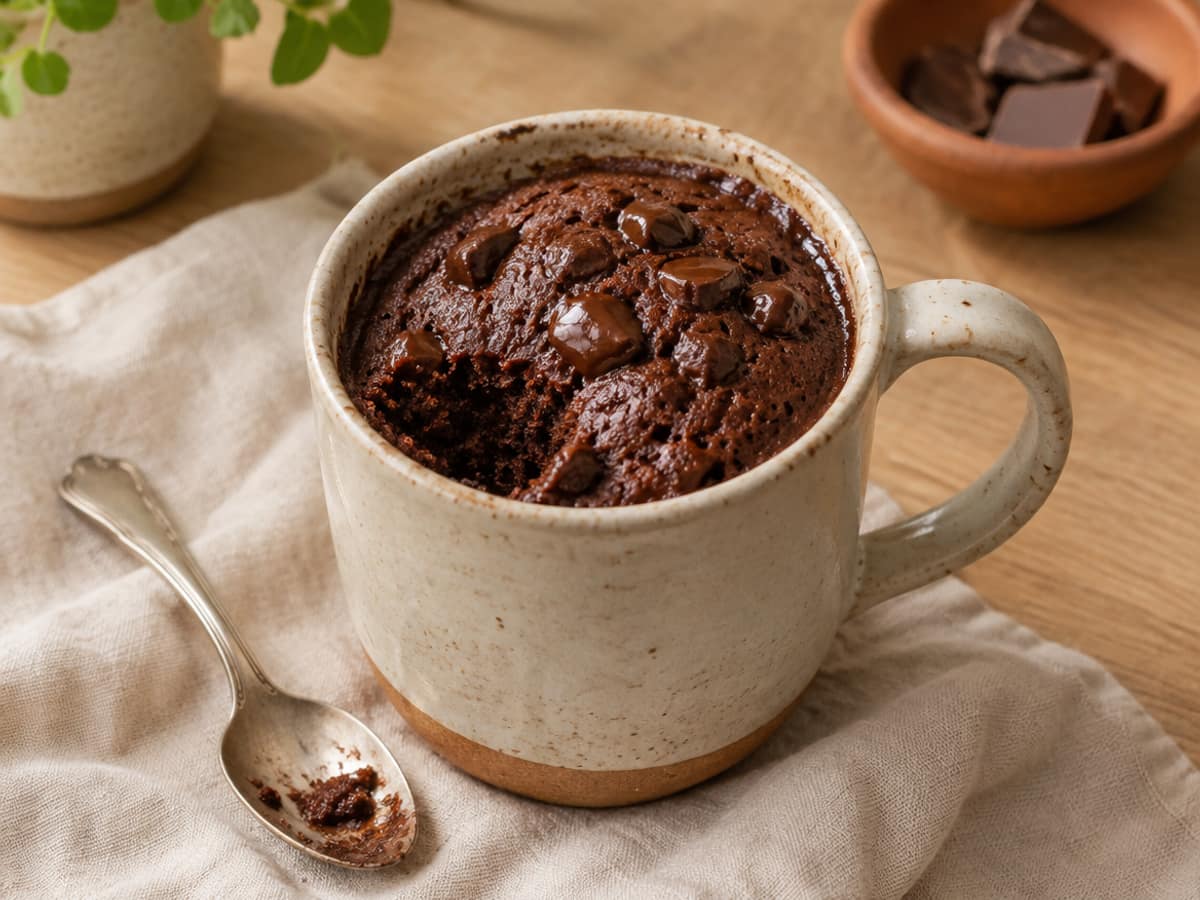
- Microwave on high for 70 to 90 seconds in a 1000-watt microwave. Look at it at 60 seconds. It will rise above the rim, then settle.
- If the center still looks wet or has dry-looking raw patches, microwave in 10-second bursts until the top looks set.
- Let the mug stand for 1 minute, then eat it from the mug with a spoon. Take care: the cake and the mug are hot.
Notes
- Microwave power varies. Times here are typical for a 1000-watt oven. A weaker microwave needs more time, so add it in 10-second bursts.
- Use a tall, straight-sided mug. A wide, shallow bowl cooks the edge before the center.
- Do not taste the batter. Raw flour can carry bacteria, and the cake is only safe once it is cooked through.
Why a mug cake works
The microwave heats the water in the batter, which turns to steam and lifts the cake. Baking powder adds more lift. There is no time for browning, so the cake is soft and moist, more like a steamed pudding than an oven cake. The oil keeps it tender. A cake that cooks this quickly also goes wrong quickly, which is why the doneness cues below matter more than the timer.
Mug size and filling
Use a mug that holds at least 12 ounces (350 ml). The batter fills about half of it, and the cake rises as it cooks. A narrow mug rises up and out. A wide mug cooks the edges before the center. Do not fill the mug more than halfway. If your mug is smaller, make a smaller batch, since a cake that overflows is a mess and cooks unevenly.
Stir the batter all the way to the bottom of the mug. Dry flour in the corners turns into hard, floury lumps that no amount of microwave time fixes.
Microwave time and wattage
Microwave ovens differ a lot in power. The wattage is usually printed on a label inside the door. This recipe is written for 1000 watts. In a weaker oven, the same cake takes longer. In a stronger one, it cooks faster and can dry out.
| Stage | What to look for |
|---|---|
| 60 seconds | The cake has risen above the rim and the top is still shiny and wet |
| 70 to 90 seconds | The top looks dry and matte and springs back when pressed |
| Past 100 seconds | The edges pull away from the mug and the cake turns rubbery |
Start at 60 seconds, look, and add 10 seconds at a time. These are typical ranges, not rules.
Doneness and safety
The cake is done when the top looks set, with no wet batter in the center. Raw flour can carry harmful bacteria, so never taste the batter, and keep microwaving if you see raw patches. The FDA explains why raw flour needs cooking. Let the mug stand for a minute, because the cake keeps cooking from the heat inside it.
Toppings and variations
- Peanut butter center: drop 1 tablespoon (16 g) of peanut butter into the middle of the batter before cooking.
- Double chocolate: use 2 tablespoons (21 g) of chocolate chips instead of 1.
- Mocha: replace the milk with 4 tablespoons (60 ml) of strong, cooled coffee.
- Serving: top with a scoop of ice cream, a spoonful of whipped cream or a dusting of powdered sugar. For a frosting, a spoonful of warm chocolate ganache works as a quick sauce.
Fixes: rubbery, dry, dense or overflowing
| Problem | Likely cause | Fix |
|---|---|---|
| Rubbery | Cooked too long | Stop at the first sign that the top is set, and use 10-second bursts |
| Dry | Too much flour, or cooked too long | Spoon and level the flour, and cut 10 seconds |
| Dense | Batter overmixed, or flour packed into the spoon | Stir until smooth, then stop; level the spoon |
| Overflowing | Mug too small or too full | Use a 12-ounce mug and fill it no more than half |
| Dry floury lumps at the bottom | Batter not mixed to the bottom | Scrape the corners with the fork |
| Raw center | Not enough time | Add 10 seconds at a time |
Because a cake this small cooks so fast, small changes in the amounts show up. Measure the flour carefully, and level the spoons. If you want a full-size cake, the one-bowl chocolate cake uses the same simple method in a 9-inch pan.
Questions and answers
Why is there no egg?
An egg is hard to divide for a single serving, so this recipe leaves it out. The oil and baking powder give the cake a soft crumb without it. Because there is no egg, the only raw ingredient to be careful about is the flour.
Can I make two mug cakes at once?
Make each one in its own mug. Do not double the batter in one mug, because it will overflow. Microwave two mugs one at a time, since two at once may cook unevenly.
Can I use whole wheat flour or a gluten-free blend?
This recipe uses all-purpose flour. Other flours absorb liquid differently, so the cake may come out denser or drier. Check it early and add milk a teaspoon at a time if the batter looks stiff.
Sources
- Handling Flour Safely: What You Need to Know — U.S. Food and Drug Administration