Fluffy Scrambled Eggs
Fluffy scrambled eggs take 4 large eggs, 2 tablespoons of milk or water, 1 tablespoon of butter and a 10-inch (25 cm) nonstick skillet over medium-low heat. Whisk the eggs well, pour them into the foaming butter, and push them gently toward the center for 2 to 3 minutes until large soft curds form and no runny liquid is left. The recipe feeds two and takes 7 minutes. For faster options with other methods, see 15 quick breakfast recipes in 10 minutes, which includes a microwave mug version, and the quick breakfast recipes hub.
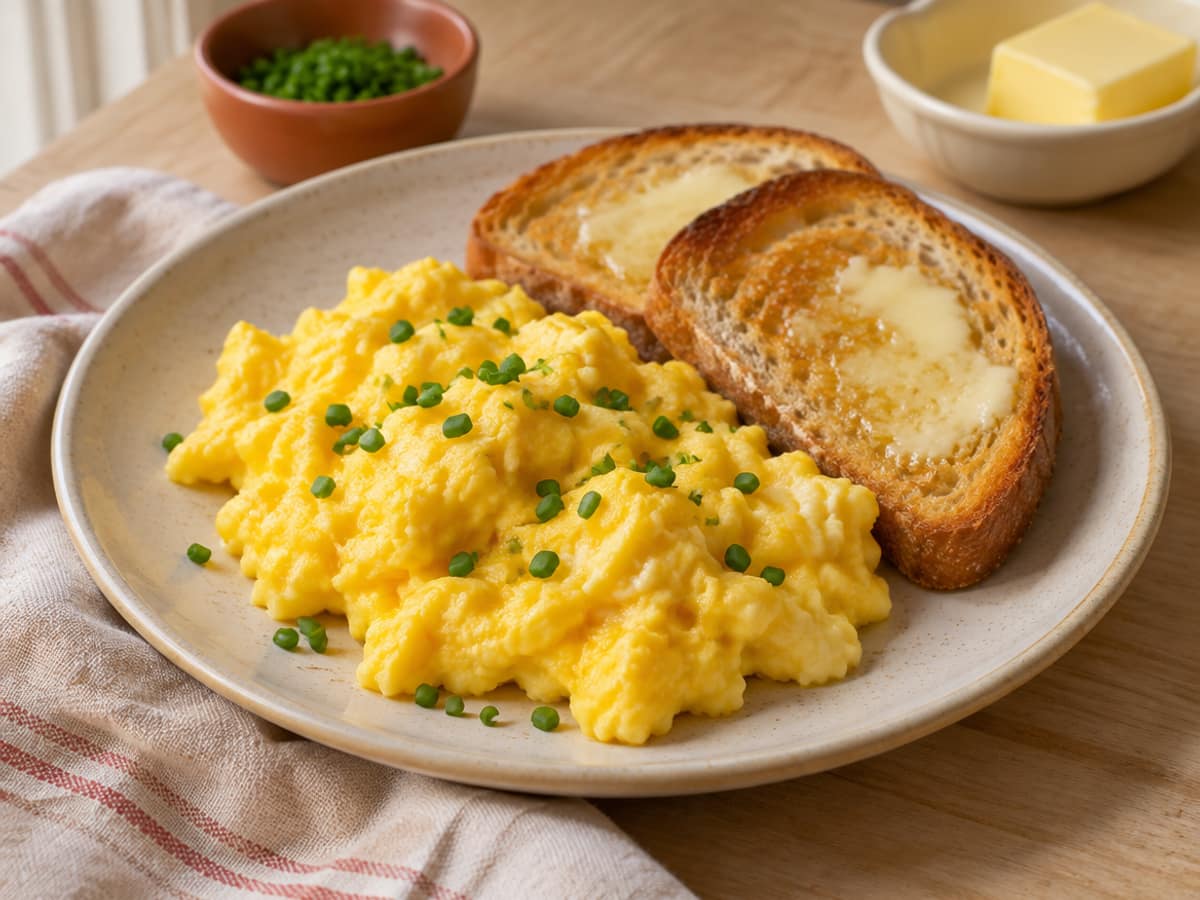
Recipe
Fluffy Scrambled Eggs
- Yield2 servings (about 1 1/2 cups cooked)
- Prep3 min
- Cook4 min
- Total7 min
Ingredients
- 4 large200 g eggs
- 2 tbsp30 ml milk or water
- 1 tbsp14 g butter
- 1/4 tsp1.5 g fine salt
- 1 pinch0.3 g black pepper
Method
- Crack the eggs into a bowl. Add the milk and salt and whisk for about 30 seconds, until the mixture is a single pale yellow with no streaks of white and a little foam on top.
- Heat the skillet over medium-low heat for 1 minute. Add the butter and swirl it as it melts, until the foam fades but the butter has not browned.
- Pour in the eggs and let them sit for 15 to 20 seconds, until the edges just start to set.
- Push the eggs gently from the edges toward the center with the spatula, so large soft curds form. Keep folding for 2 to 3 minutes.
- When no runny liquid egg is left but the curds still look moist and shiny, take the pan off the heat. Stir once more, add the pepper and serve right away.
Notes
- Use a 10-inch (25 cm) pan for 4 eggs. A pan that is too large spreads the eggs thin so they cook fast and dry out.
- Add cheese or chopped chives during the last 30 seconds of cooking so they warm through without making the eggs watery.
Why this method works
Scrambled eggs turn tough when the proteins in the egg bind tightly and squeeze out water. Gentle heat and constant movement keep the curds large and the proteins loosely linked, so the eggs stay soft. Three choices matter most:
- Whisk until smooth. Mixing the whites and yolks fully means every curd cooks at the same speed.
- Medium-low heat. High heat sets the outside before the inside, which gives dry, rubbery edges and wet centers.
- Take them off early. Eggs keep cooking from the heat of the pan. Remove it when the last liquid has set, not when the eggs look completely dry.
Egg safety
The FDA advises cooking eggs until both the yolk and the white are firm, and says scrambled eggs should not be runny. This is why the recipe takes the pan off the heat when no runny liquid is left, not earlier. Keep eggs in the refrigerator at 40°F (4°C) or below. The FDA also says to serve cooked eggs and egg dishes immediately after cooking, to refrigerate leftovers within 2 hours (1 hour when it is above 90°F (32°C)), and to reheat them to 165°F (74°C) before serving. Leftover cooked egg dishes should be used within 3 to 4 days, according to the same page.
Amounts for different crowds
| Servings | Eggs | Milk or water | Butter | Pan size |
|---|---|---|---|---|
| 1 | 2 large (100 g) | 1 tbsp (15 ml) | 1 tsp (5 g) | 8-inch (20 cm) |
| 2 | 4 large (200 g) | 2 tbsp (30 ml) | 1 tbsp (14 g) | 10-inch (25 cm) |
| 4 | 8 large (400 g) | 1/4 cup (60 ml) | 2 tbsp (28 g) | 12-inch (30 cm) |
Add salt at the rate of 1/4 teaspoon for every 4 eggs. For 8 eggs, cook in one pan only if it is 12 inches (30 cm) wide; otherwise, cook in two batches so the eggs do not steam.
Add-ins
Add these in the last 30 seconds so they do not water down the eggs.
- Cheese: 1/4 cup (30 g) shredded cheddar or 2 tablespoons (10 g) grated Parmesan.
- Herbs: 1 tablespoon (3 g) chopped chives or parsley.
- Vegetables: cook 1/2 cup (70 g) finely diced pepper or mushrooms in the butter first, then add the eggs.
- Cream cheese: 2 tablespoons (30 g) in small cubes, for creamier curds.
Fixes
- Rubbery: the heat was too high or the eggs cooked too long. Lower the heat and take them off sooner.
- Watery: the eggs were removed before the liquid set, or you added wet vegetables raw. Cook them a little longer, and cook vegetables first.
- Browned: the butter was too hot. Use medium-low heat and add the eggs once the foam fades and before the butter browns.
- Sticking: use a nonstick pan, and make sure the butter coats the whole surface before the eggs go in.
- Bland: salt the eggs before cooking and add pepper or herbs at the end.
More egg breakfasts
If you want eggs in a sandwich, tacos or an omelet, 15 quick breakfast recipes in 10 minutes has several. For recipes built around a protein ingredient, see high-protein quick breakfasts. To bake eggs into a batch for the week, try egg muffin cups, or pair scrambled eggs with a stack from easy pancakes from scratch.
Questions and answers
Why add milk to scrambled eggs?
A little liquid thins the egg so it whisks smooth and scrambles into softer curds. Two tablespoons for 4 eggs is a common ratio. You can leave it out, and the eggs will be a little denser.
How do I know when scrambled eggs are done?
The FDA says to cook eggs until the yolk and white are firm and that scrambled eggs should not be runny. Take the pan off the heat when no liquid egg is left but the curds still look moist.
Why are my scrambled eggs rubbery or watery?
Rubbery eggs cooked too hot or too long. Watery eggs were taken off the heat before the liquid set, or they sat after cooking. Use medium-low heat and serve right away.
Sources
- What You Need to Know About Egg Safety — U.S. Food and Drug Administration