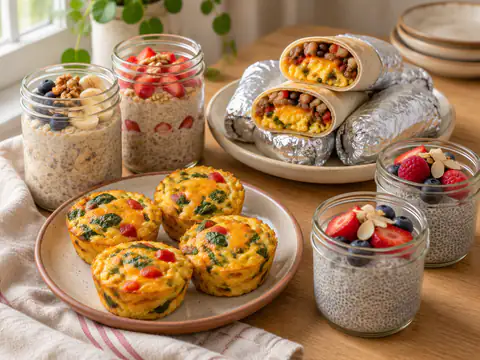
Egg Muffin Cups
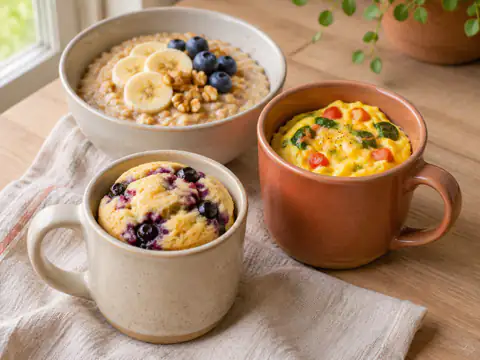
Egg muffin cups are 8 eggs whisked with a little milk, poured over spinach, bell pepper, ham and cheese in a 12-cup muffin pan, and baked at 350°F (180°C) for 18 to 22 minutes. They are done when the tops are set and a thermometer reads 160°F (71°C) in the center. The recipe makes 12 cups, which is 6 servings of 2, and keeps in the refrigerator or freezer for quick mornings. For a bigger bake, the savory egg bake in make-ahead breakfasts for busy mornings uses a 9 x 13-inch dish, and the stovetop method is in fluffy scrambled eggs. More ideas are in the quick breakfast hub.

Recipe
Egg Muffin Cups
- Yield12 egg cups (about 56 g each)
- Prep15 min
- Cook20 min
- Total35 min
- Oven350°F / 180°C
Ingredients
Egg mixture
- 8 large400 g eggs
- 1/3 cup80 ml milk
- 1/2 tsp3 g fine salt
- 1/4 tsp0.5 g black pepper
Fillings
- 1 cup loosely packed20 g baby spinach, chopped
- 1/3 cup50 g red bell pepper, finely diced
- 1/3 cup60 g cooked ham, finely diced
- 1/2 cup55 g shredded cheddar
For the pan
- 1 tbsp14 g butter or neutral oil, or use silicone liners
Method
- Heat the oven to 350°F (180°C) with a rack in the center. Grease all 12 muffin cups well, or use silicone liners.
- Whisk the eggs, milk, salt and pepper in a large measuring cup until no streaks of white remain.
- Divide the spinach, pepper, ham and cheese evenly among the 12 cups, about 2 tablespoons of fillings in each.
- Pour the egg mixture over the fillings, about 2 2/3 tablespoons (40 ml) per cup. The eggs puff as they bake.
- Bake for 18 to 22 minutes, until the tops are puffed and set and a knife inserted in the center comes out clean. A thermometer in the center of a cup should read 160°F (71°C).
- Let the cups stand in the pan for 5 minutes, then run a knife around each and lift them out. Serve warm.
Notes
- Do not overfill the cups. Three-quarters full leaves room for the eggs to puff.
- Cook watery vegetables, such as mushrooms or zucchini, first and drain them. Raw wet vegetables make watery cups.
- For a vegetarian version, leave out the ham and use 1/3 cup (50 g) of diced tomato and 2 tablespoons of chopped scallion.
Why this ratio works
The mixture is 8 eggs to 1/3 cup of milk, a little under 1 tablespoon per egg. That is just enough liquid to keep the cups tender without making them wet. The fillings add about 190 g, so 12 cups of about 56 g each use the whole batch. Each cup is filled about three-quarters, because the eggs puff as they bake.
The fillings are cut small so each bite has some of everything, and the cheese goes under the egg so it melts into the cup instead of browning on top.
Doneness and egg safety
The FDA says to cook eggs until the yolk and white are firm, and to cook casseroles and other dishes containing eggs to 160°F (71°C). Egg cups are small, so a thermometer in the center of a middle cup is the quick check. If it is below 160°F (71°C), give the pan 2 more minutes.
Wash vegetables under running water before you cut them, as the FDA advises for produce.
Fillings that work
| Filling | Amount for 12 cups | Prep |
|---|---|---|
| Spinach, bell pepper, ham, cheddar | As in the recipe | Dice small |
| Tomato and scallion | 1/3 cup (50 g) diced tomato, 2 tbsp sliced scallion | Pat the tomato dry |
| Mushrooms and Swiss | 1/2 cup (about 40 g) cooked mushrooms, 1/2 cup (55 g) Swiss | Cook the mushrooms first and drain |
| Cooked sausage and pepper jack | 1/3 cup (about 55 g) crumbled sausage, 1/2 cup (55 g) cheese | Use fully cooked sausage |
| Broccoli and feta | 1/2 cup (about 45 g) chopped steamed broccoli, 1/3 cup (45 g) feta | Squeeze the broccoli dry |
Keep the total filling near 190 g so the cups stay full but not overflowing.
Storing, freezing and reheating
Cool the cups and put them in the refrigerator within 2 hours, or within 1 hour when the air is above 90°F (32°C). The FDA says to use cooked egg dishes within 3 to 4 days. For the freezer, set the cooled cups on a tray until firm, then bag them. Label the bag with the date and use the oldest first.
To reheat, heat until the center reaches 165°F (74°C), the FDA’s temperature for reheated cooked egg dishes. A microwave leaves cold spots, so turn the cup halfway and let it stand 3 minutes before you check, which is the longer of the two USDA FSIS standing times. A 350°F (180°C) oven also works: about 12 to 15 minutes from frozen, wrapped in foil, as a planning range.
Troubleshooting
| Problem | Likely cause | Fix |
|---|---|---|
| Rubbery | Baked too long or too hot | Pull the pan when the centers are set; check at 18 minutes |
| Watery bottoms | Wet vegetables or too much milk | Cook and drain wet vegetables first |
| Stuck to the pan | Too little grease | Grease every cup and the top surface, or use silicone liners |
| Sunken centers | Underbaked, or they cooled quickly | Bake until 160°F (71°C) and let them stand 5 minutes |
| Uneven cups | Filled unevenly | Use a spouted measuring cup and pour about 2 2/3 tablespoons (40 ml) into each |
To make the same filling into portable meals, try freezer breakfast burritos. For eggs cooked fresh on the stove in under 10 minutes, see 15 quick breakfast recipes in 10 minutes.
Questions and answers
How do you keep egg muffin cups from sticking?
Grease every cup well, including the top edge of the pan, or use silicone liners. Let the cups stand 5 minutes after baking, then run a knife around each one.
How do you reheat egg muffin cups?
Reheat until the center reaches 165°F (74°C), which is the temperature the FDA gives for reheating cooked egg dishes. In a 1000-watt microwave, one cup takes about 30 to 45 seconds from the refrigerator, or 1 1/2 to 2 minutes from frozen, plus 3 minutes of standing time. These are planning ranges, so check with a thermometer.
Why are my egg muffin cups rubbery or watery?
Rubbery cups were baked too long or at too high a heat. Watery cups have wet vegetables, or too much milk. Use the amounts here and pull the pan when the centers are set.
Sources
- Cooking with Microwave Ovens — USDA Food Safety and Inspection Service
- What You Need to Know About Egg Safety — U.S. Food and Drug Administration
- Are You Storing Food Safely? — U.S. Food and Drug Administration
- Selecting and Serving Produce Safely — U.S. Food and Drug Administration